

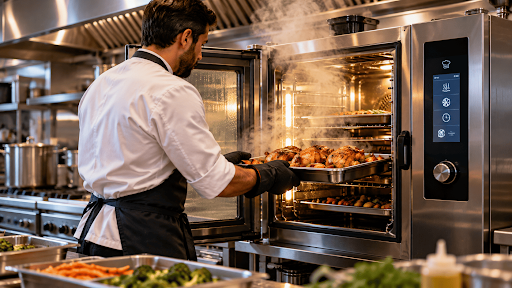
Walk the line in a busy hotel or banquet kitchen and you’ll often notice what’s missing. There’s no bank of steamers, no separate proofing cabinet, and fewer ovens than you’d expect for the volume coming out of it. In many of those kitchens, a combi oven is doing the work of all of them.
So what is a combi oven, exactly, and does it belong in your kitchen? This guide covers how it works, what it’s used for, which operations get the most out of one, and why it costs more than the convection oven it often replaces.
What Is a Combi Oven?
A combi oven, short for combination oven, is a commercial oven that can cook with dry convection heat, with steam, or with a controlled mix of both. You’ll also hear it called a combi steamer or a combi steam oven. They’re all the same piece of equipment.
What sets it apart is humidity control. A standard convection oven can only add dry heat, so food loses moisture as it cooks. A combi oven lets the cook decide how much moisture stays in the cavity, which changes how proteins hold their juices, how bread forms a crust, and how evenly a full pan of vegetables cooks through.
How Does a Combi Oven Work?
Inside, a commercial combi oven pairs a convection fan and heating elements or gas burners with a system that produces steam. Sensors read the temperature and humidity in the cavity, and the controls adjust both throughout the cook. Most models also include a core temperature probe, so the oven can finish a roast based on its internal temperature rather than a timer.
There are two main ways to make steam. Boiler-based models heat water in a separate boiler and feed steam into the cavity. They produce a large volume of steam quickly, which suits kitchens that steam heavily all day.
A boilerless combi oven sprays water directly onto a hot surface inside the cavity to create steam on demand. Boilerless units generally use less water and have one less component to descale, which is why they’re common in smaller and countertop models.
What Are the Three Main Cooking Modes?
Almost every combi oven is built around three modes. Most modern units add programs on top of these, but these are the foundation.
Convection Mode
Dry, circulated hot air, just like a convection oven. It’s the mode for browning, crisping, and baking anything that needs a dry finish, from sheet-pan potatoes to cookies.
Steam Mode
Moist heat with no added dry heat. Vegetables, rice, seafood, and dumplings cook evenly and quickly without drying out, and color tends to hold up better than in a pot of boiling water.
Combination Mode
Hot air and steam at the same time, with the oven managing the humidity level. This is where a combi oven earns its name. Roasted meats come out with a browned exterior and less moisture loss, and reheated plates stay fresh instead of turning dry around the edges.
What Is a Combi Oven Used For?
Because one oven can switch between dry heat and moist heat, the list of jobs it can handle is long. In commercial kitchens, combi ovens are commonly used for:
- Roasting chicken, pork, beef, and turkey with less shrinkage
- Steaming vegetables, fish, shellfish, and grains in full hotel pans
- Baking bread and pastries with a burst of steam for crust and volume
- Braising and slow cooking, including overnight low-temperature cooks
- Rethermalizing plated meals and banquet pans without drying them out
- Proofing dough at a controlled temperature and humidity
- Batch cooking eggs, breakfast items, and sides for high-volume service
The practical payoff is consolidation. A kitchen that once needed a convection oven, a steamer, and sometimes a separate holding or proofing cabinet can often cover most of that work with one combi.
Which Kitchens Get the Most From a Combi Oven?
Combi ovens tend to pay off fastest where the menu is broad and the volume is high. Hotels, banquet halls, and caterers rely on them to cook and rethermalize large quantities at once, which is a big part of why they show up in so many kitchens preparing for catering and banquet season.
Schools, hospitals, and other institutional kitchens use them for the same reason: one appliance, many menu items, consistent results across a long service.
They also make sense in smaller kitchens where space is the constraint. A countertop combi can stand in for equipment there’s simply no room for. On the other hand, if your menu is mostly bread, pastries, and items that need a dry finish, a convection oven may do everything you need for far less money.
Why Does a Combi Oven Cost More Than a Convection Oven?
A combi oven is essentially several appliances in one box. Along with the convection system, it carries a steam generator, humidity sensors, more advanced controls, and often an automatic cleaning system. It also needs a water supply and a drain, which a convection oven doesn’t.
That’s why the price gap between the two is significant. We break down typical price ranges and the trade-offs in our comparison of convection ovens vs. combi ovens.
The upfront cost is only part of the picture. Combi ovens can reduce the number of appliances you buy and maintain, and better moisture control means less product lost to shrinkage. Efficiency varies by model as well. According to ENERGY STAR, certified electric combination ovens can save about $1,200 a year in utility costs compared to standard models, and certified gas models about $500 a year.
What Do You Need Before Installing a Combi Oven?
A combi oven has more utility needs than a typical oven, so it pays to check them before choosing a model.
Power is the first one. Combi ovens range from smaller units that run on standard voltage to large electric models that need 480V three-phase service, and gas models need the right gas connection and supply. Water and drainage come next, with many manufacturers specifying water quality limits in their warranty terms.
Ventilation depends on the model and on local code. Some combi ovens are installed under a hood, while others offer built-in condensation or vapor-control options. Your local code official has the final say. Clearance, stand height, and workflow around the door matter too, because loading full pans of hot liquid is not something you want to do in a cramped corner.
If you’re planning a new kitchen or reworking your cook line, our design services can help you place the oven and plan the hookups before anything is delivered.
Are There Downsides to a Combi Oven?
A combi oven isn’t the right call for every kitchen. The upfront cost is real, and the extra components mean more to maintain, especially in hard-water areas. There’s also a learning curve. Staff who are used to setting a temperature and a timer need some time with humidity settings, probes, and programs before the oven pays off.
For a kitchen with a simple dry-heat menu, those trade-offs may outweigh the benefits. For a kitchen that steams, roasts, bakes, and reheats in volume every day, they usually don’t.
How Do You Choose the Right Commercial Combi Oven?
Start with capacity. Combi ovens are sized by how many hotel pans they hold, commonly in 6, 10, and 20-pan configurations, in half-size or full-size pans. Size to your busiest service, not your average one.
From there, the main choices are gas or electric, boiler or boilerless, and the type of controls. Some kitchens want simple button controls their staff can learn in a day. Others want programmable touchscreen controls that store recipes and run unattended.
Automatic cleaning is worth weighing too. A self-cleaning cycle saves labor at the end of every night, and it pairs well with a regular routine like the one in our commercial kitchen cleaning checklist.
Our selection includes combi ovens from manufacturers like Rational, Unox, Blodgett, and Atosa, in countertop, half-size, and full-size models. If you’re not sure which one fits your volume, request a quote and one of our Equipment Consultants will walk you through the options.
Frequently Asked Questions
What Can You Cook in a Combi Oven?
Almost anything you would roast, bake, steam, braise, or reheat. Combi ovens handle proteins, vegetables, seafood, rice, bread, pastries, eggs, and plated meals, which is why they’re popular in kitchens with large or varied menus.
How Much Does a Combi Oven Cost?
Price depends on size, fuel type, and features. Entry-level and countertop models cost the least, while full-size models with advanced controls and automatic cleaning sit at the top of the range. Our convection vs. combi comparison covers typical price ranges, and we can quote specific models for your kitchen.
Is a Combi Oven Better Than a Microwave?
They do different jobs. A microwave heats small portions quickly but can heat unevenly and won’t brown or crisp food. A combi oven reheats full pans evenly while keeping moisture and texture, so it’s better suited to volume rethermalizing. Many kitchens use both.
What Is the Difference Between a Combi Oven and a Steamer?
A commercial steamer cooks only with steam. A combi oven can steam too, but it can also roast and bake with dry heat or combine the two. If your kitchen only needs steaming, a dedicated steam cooking unit may be enough.
Do Combi Ovens Need a Hood?
It depends on the model, how it’s used, and local code. Many combi ovens are installed under a hood, and some models offer built-in condensation or vapor-control systems. Check with your local code official before finalizing the layout.
Do Combi Ovens Need a Water Filter?
Most manufacturers strongly recommend water treatment, and many tie warranty coverage to meeting their water quality requirements. Filtration protects the steam system from scale, which is one of the most common causes of combi oven service issues.
Find the Right Combi Oven for Your Kitchen
Whether you’re replacing a convection oven or building a new cook line around one, the right combi oven depends on your menu, your volume, and your space. Browse our selection of combi ovens, visit our showroom in Springfield, VA, or call us at 703-644-6666 to talk with our team.