
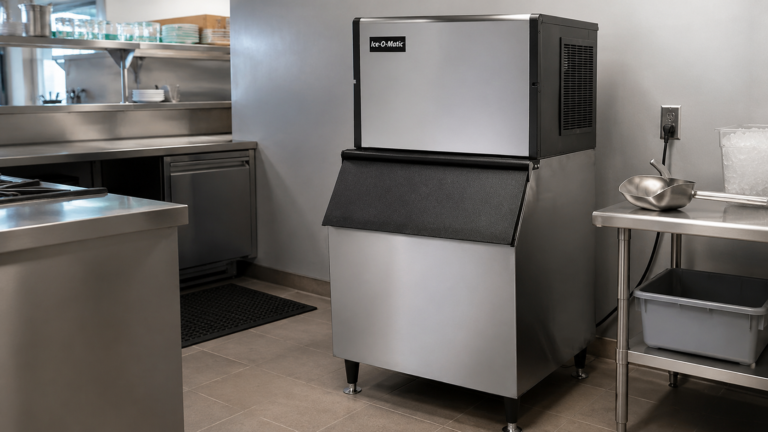
A commercial ice machine is one of the few pieces of equipment in your kitchen that almost never stops. The fryer cools down overnight. The dish machine sits idle between services. The ice machine keeps cycling, refilling the bin and holding temperature so there is ice ready for the next rush.
That constant operation is why its energy use tends to go unnoticed, and why the question of whether ice machines use a lot of electricity is better answered with real numbers than a guess. Here is what a commercial ice machine actually costs to run, what drives that cost up or down, and how to keep it predictable.
How Much Electricity an Ice Machine Actually Uses
The Number That Matters: kWh per 100 lb
Energy use on ice machines is measured in kilowatt-hours per 100 pounds of ice produced, written as kWh/100 lb. A modern, efficient air-cooled cube machine lands somewhere around 5 to 9 kWh/100 lb. Older or neglected units can push past 12, which means two machines making the same ice can cost very different amounts to run.
What That Looks Like on Your Monthly Bill
A mid-sized machine making about 250 pounds of ice a day runs roughly 500 kWh a month, close to what a home refrigerator uses across two to three months. A larger 500 lb/day air-cooled machine uses closer to 5,000 kWh a year. At the commercial rates most DC-area restaurants pay, between $0.12 and $0.18 per kWh, that machine costs about $600 to $900 a year to run on its own, separate from the walk-in or the cooking line.
| QUICK TIPWhen you compare two machines, look past the sticker price to the kWh/100 lb rating on the spec sheet. A unit that costs a little more up front but uses fewer kilowatt-hours usually wins over the years you will actually own it. |
What Makes One Machine Cost More Than Another
Two machines producing the same amount of ice can carry very different bills, and a few factors explain most of the difference. The compressor does most of the work, accounting for 70 to 85 percent of total energy use, so anything that makes it run harder shows up directly on your bill.
Ambient Heat
Heat around the machine is the largest factor. Every 10 degrees added to the room forces the compressor to run 5 to 10 percent longer per cycle, so a unit tucked next to the cookline or in a hot back corner costs more to run than the same unit in a cool, ventilated spot. Placement is one of the cheapest ways to lower the bill.
Air-Cooled vs Water-Cooled
Cooling method matters too. Water-cooled units draw about 15 percent less electricity, but they use 100 gallons or more of water per 100 pounds of ice, and at commercial water rates that often cancels out the electrical savings. Some local water codes also limit them. Air-cooled units are the more common choice for that reason, while water-cooled units still make sense in specific cases, such as a kitchen that runs hot all day or a raw bar that needs a flaker. The right call depends on your space and how you use ice, which is exactly what our ice machine leasing consultants help you weigh.
Incoming Water Temperature
The temperature of the water feeding the machine has an effect as well. Warmer incoming water has to be chilled further before it can freeze, so the compressor runs longer to complete each cycle. This is one reason placement and plumbing are worth getting right at installation rather than working around them later.
Condition and Cleanliness
Condition matters as much as the original specification. A condenser coil covered in grease and dust acts like insulation and can add a 30 percent energy penalty on its own. The difference between a clean machine and a neglected one is significant, and it is entirely avoidable.
How Ice Stacks Up Against the Rest of the Kitchen
A single ice machine usually does not carry the largest monthly bill in the building. Unlike your dish machine, which sits idle between services, the ice machine runs constantly, so its cost is steady and predictable rather than spiky. It does draw a high starting current and release a concentrated burst of heat during each harvest cycle, which is why it often needs its own dedicated breaker.
Because it runs all the time, small differences add up. Over a five-year period, the gap between an efficient machine and a wasteful one becomes substantial. On a single 500 lb/day unit, that difference can exceed a thousand dollars across five years.
What an Efficient Machine Does Differently
ENERGY STAR certified ice machines use roughly 15 to 20 percent less energy than standard models. On a high-output machine, that can mean about 1,200 fewer kWh per year, or roughly $144 to $216 in annual savings before accounting for reduced water use.
The savings come from better compressors, improved insulation that holds the cold, and more efficient harvest cycles that use less energy to release each batch of ice. The machine fills the same bin by the end of the shift while drawing fewer kilowatt-hours. The higher purchase price of an efficient model is usually recovered through lower energy and water bills well within the unit’s service life, which is why it pays to compare the ice machines we carry on running cost rather than sticker price alone.
Sizing the Machine Correctly
An oversized machine is a common and costly mistake. When it produces far more ice than you use, it cycles more often than necessary and you pay to make ice that melts in the bin. An undersized machine runs almost continuously to keep up, which increases wear and raises consumption in a different way.
Sizing is based on your guest count and how you use ice. As a general guide:
- Sit-down restaurants: about 1.7 pounds of ice per guest.
- Fast-casual operations: closer to 0.9 pounds per guest.
- Hotels: roughly 3 to 5 pounds per room.
- Self-serve beverage stations: 2 to 3 pounds per customer, since refills add up.
Whatever the number, size for your busiest day rather than your average one, then add a buffer of about 20 percent on top. A correctly sized machine spends more time idle and less time drawing power. It is also worth noting that ice type affects consumption: nugget and flake machines work the water differently than standard cube machines, so two units rated for the same daily output can use different amounts of energy depending on the ice they produce.
The Role of Maintenance
A well-built machine becomes expensive when it is not maintained. Coils collect dirt, water lines scale up, and the machine compensates by running longer and using more power. A neglected condenser alone carries the 30 percent energy penalty mentioned earlier. Regular service prevents breakdowns and keeps consumption in check, which is the part of ownership most operators have little time to manage. A lease program that folds maintenance in takes that task off your plate entirely.
Frequently Asked Questions
Do commercial ice machines use a lot of electricity?
They use a steady, meaningful amount because they run around the clock, but a modern, correctly sized, well-maintained unit is far from a power hog. Most of the waste people worry about comes from oversized, poorly placed, or dirty machines rather than from ice making itself.
How much does it cost to run a commercial ice machine per month?
A mid-sized 250 lb/day machine uses around 500 kWh a month, which at typical DC-area commercial rates works out to roughly $60 to $90 a month. A larger 500 lb/day unit runs closer to $600 to $900 a year. Actual cost depends on your rate, the room temperature, and how clean the machine is kept.
Are air-cooled or water-cooled ice machines cheaper to run?
Water-cooled units draw about 15 percent less electricity, but the extra water they use usually erases that saving once you factor in commercial water rates. For most kitchens, an air-cooled machine in a ventilated spot is the more economical choice, with water-cooled reserved for specific situations.
Does a commercial ice machine need its own dedicated circuit?
Usually yes. Ice machines draw a high starting current and cycle frequently, so a dedicated breaker keeps them from tripping the circuit or interfering with other equipment. Confirm the electrical requirements before installation so the machine has the supply it needs.
Is an ENERGY STAR ice machine worth it?
For a unit that runs every day, yes. The 15 to 20 percent energy saving, around $144 to $216 a year on a high-output machine, typically recovers the price difference well within the machine’s service life, before counting any water savings.
Keep Your Ice Costs Predictable
Ice machines can use a meaningful amount of electricity, particularly when a unit is the wrong size, poorly placed, or rarely cleaned. A correctly sized and well-maintained machine has a predictable operating cost and reliable output, which is the whole point of getting the setup right from the start.
We lease ice machines to restaurants across Washington DC, Northern Virginia, and Maryland, and we lease only Hoshizaki units, serviced by our in-house Hoshizaki technicians. When you lease with us, we size the machine to your operation from day one, so you are not paying to produce ice you will not use. Maintenance is handled by our team, and our service guarantee means that if a machine goes down, we get you running again by your next meal and supply ice in the meantime.
Want to know which machine fits your kitchen? Talk to our leasing consultants in Springfield, or request a quote to find the most efficient option for your operation.